

Memory
Admin → Memory
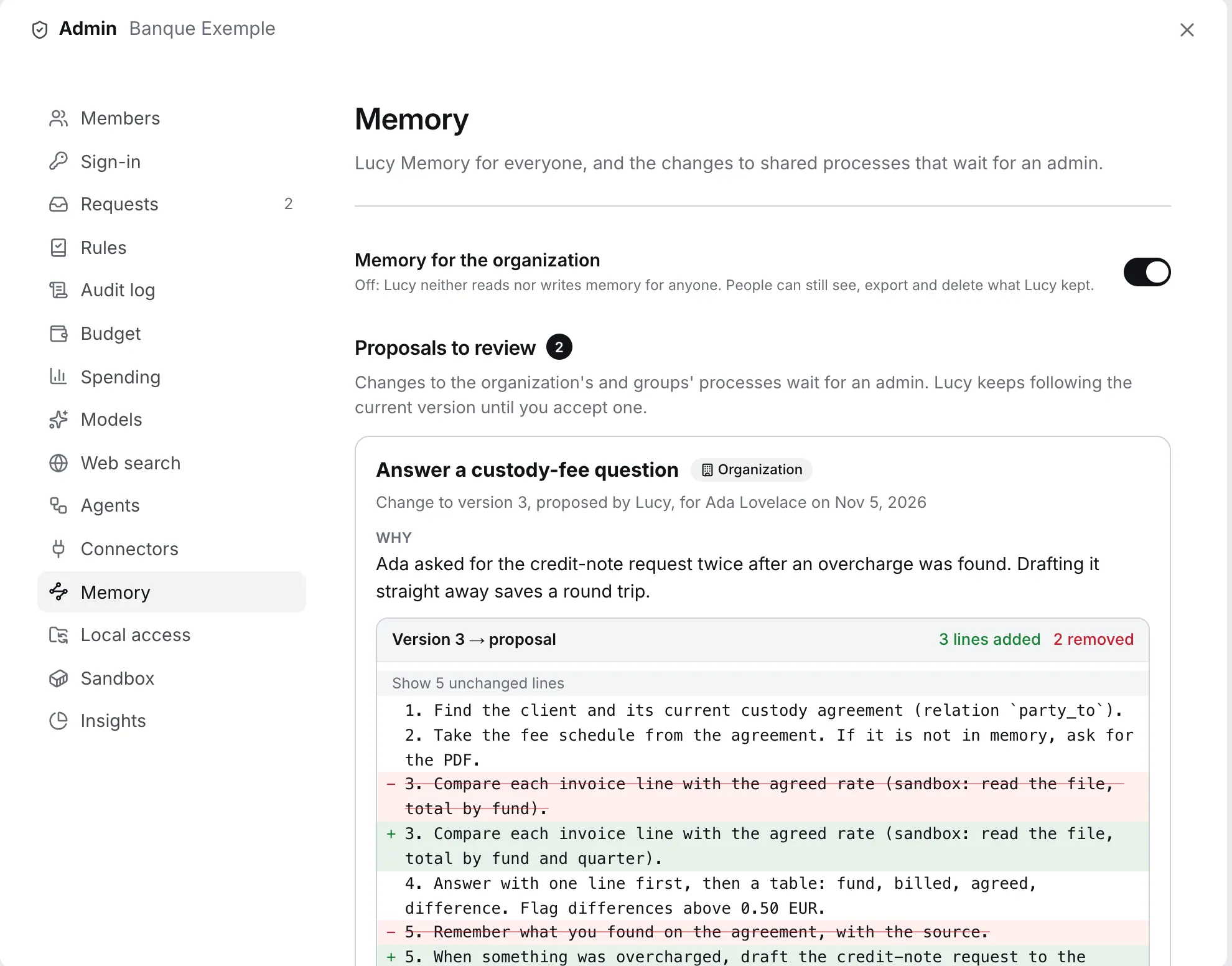
What memory is
Section titled “What memory is”Lucy can keep processes (how things are done here) and knowledge (facts about people, companies and contracts, with their sources) between conversations. It is the feature that makes Lucy get better at your work.
The switch
Section titled “The switch”Memory is available when your contract includes it. Then, per organisation: on (default when included) or off for everyone.
When off, Lucy neither reads nor writes memory. People can still see, export and delete whatever was stored, which respects data-subject rights.
Scopes
Section titled “Scopes”Every memory has a scope:
| Scope | Visible to | Typical content |
|---|---|---|
user |
Only the person | Personal preferences, drafts of processes |
group |
Members of one group | A team’s playbook |
org |
Everyone | Company-wide processes |
Lucy writes to a person’s own scope. Sharing wider is the person’s decision, and a process shared with a group or the organisation stays a proposal until an admin accepts it. You are the quality gate for what everyone follows.
Why switch it on
Section titled “Why switch it on”- New joiners benefit from the team’s processes from day one.
- Repeated tasks take one sentence instead of one page of instructions.
- Answers show when a memory was used, which keeps behaviour explainable.
Why you might keep it off
Section titled “Why you might keep it off”Start with it off if you have not yet decided how long memory should be retained or who may share it. You can turn it on later without losing the option.
Privacy
Section titled “Privacy”Admins can see an organisation’s shared memory and a member’s, as part of oversight, and the audit log records changes. Deleting a member deletes their memory.
Examples
Section titled “Examples”A shared playbook, reviewed
Section titled “A shared playbook, reviewed”Situation: The finance team has a fee check routine that everyone should follow. Setup: A senior analyst writes the process and shares it with the Finance group. It appears as a proposal. You review and accept it. Result: Everyone’s “fee check” follows the same steps. Changing the method is a new version you accept again.
Starting cautiously
Section titled “Starting cautiously”Situation: Your DPO wants to understand memory before it is widely available. Setup: Keep memory off for the organisation, then turn it on for a pilot, and review what is stored in the pilot’s memory pages. Result: You see real examples, set the rules, and then widen.
A leaver and their memory
Section titled “A leaver and their memory”Situation: A person leaves. Setup: Remove the member. Result: Their personal memory is deleted. What they shared with the organisation stays, because it belongs to the organisation.